
Reader questions
Questions readers send us about eye nutrition
These are the questions that come up most often in our inbox, answered as directly as we can. Where the evidence is mixed, we say so rather than picking the reassuring answer. If your question isn't here, the contact page is open.
What this page is
Straight answers about lutein, zeaxanthin, omega-3s, zinc and AREDS2 formulas, plus the parts of eye nutrition that marketing usually skips.
Written for readers in Indonesia. We do not sell supplements and we do not rate products.
What comes up most in the inbox
Most messages fall into six groups: which nutrients actually matter, what lutein and zeaxanthin do, how AREDS differs from AREDS2, whether omega-3s help with dry eye, when food is enough, and what nutrition realistically cannot do. Each group has its own answer below, with links to the longer pages when a topic needs more room than a paragraph.
Nutrient basics
Which nutrients actually have research behind them?
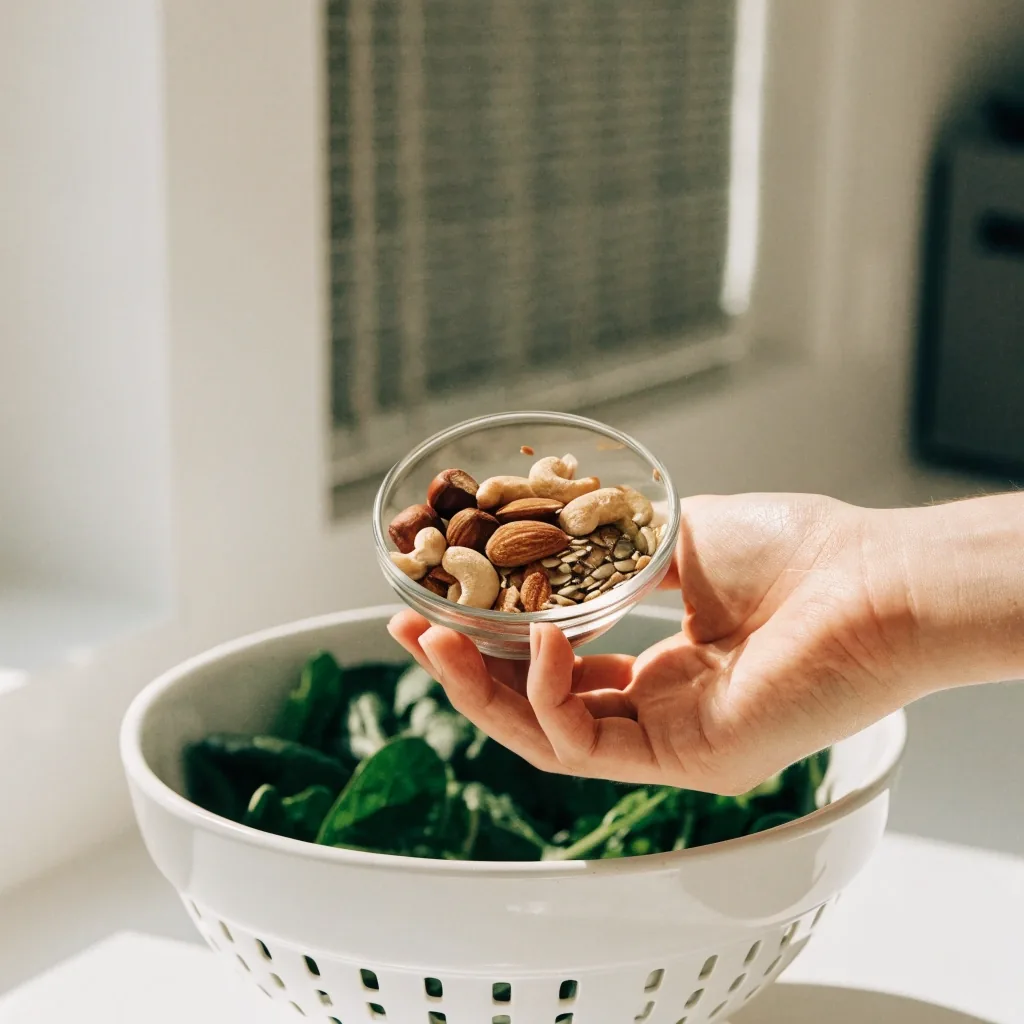
The nutrients with the most consistent research attention are lutein, zeaxanthin, vitamin C, vitamin E, zinc, and omega-3 fatty acids, with vitamin A and selenium also discussed. None of them improves vision on its own. The reason is partly that they interact, and partly that eye health is a long-term maintenance story rather than a short-term fix. A varied diet covering several of these beats a focused bet on one.
They work as a group
Carotenoids, vitamin C, vitamin E and zinc appear together in the same diets and the same studies, which makes single-nutrient claims hard to separate out.
Timeline is years
Dietary patterns and eye health are studied across decades, not weeks. That mismatch is why results are rarely visible to you.
Variety beats one bottle
Eating across greens, fish, eggs, nuts and seeds covers several nutrients at once and costs less than chasing a single one.
Do lutein and zeaxanthin really reach the eye?
These two carotenoids accumulate in the macula and help filter short-wavelength light before it reaches the photoreceptors. They're also fat-soluble, so eating greens with a little oil genuinely improves how much you absorb. Expectation-setting matters here: the point is a dietary pattern over years, not a change you'd notice next week.
If you cook with oil, toss the greens in it rather than pouring it over at the end, and pair them with a source of fa in the same meal. Spinach, kale, water spinach and mustard greens all carry both carotenoids, and chopped-and-cooked greens release more than raw ones. Absorption also varies between people, which is one reason studies look at groups rather than individuals.
Quick answer
Yes, they reach the macula from food. What that means for your vision over time is a different question, and it is answered by long studies rather than by a single meal.
Fat-soluble means the body needs some dietary fa alongside them to take them up.
AREDS
Vitamin C, vitamin E, beta-carotene, zinc and copper
The earlier formula. It was studied in people with certain stages of age-related macular degeneration, and it is the reference point every later comparison is measured against.
AREDS2
Lutein and zeaxanthin in place of beta-carotene
The later formula. Follow-up data described this version as more effective and safer than the beta-carotene version, which is why most current formulations follow it.
Both were studied in people with certain stages of AMD. Neither is a general vision supplement, and that's the part most often lost in marketing. If you have been told you have a specific AMD stage, the AREDS2 composition is the one worth discussing with a clinician; if you have not, the formula is not a general-purpose multivitamin and it is not designed for healthy eyes.
Do omega-3s help with dry eye?
Omega-3s are widely discussed for dry eye and appear in fish, flaxseed, and walnuts. The evidence is mixed, and reviews of omega-3 supplements have not shown a clear benefit for AMD. Dry eye and AMD are separate conditions, so a result in one doesn't transfer to the other. Keep the two conversations separate when you talk to a clinician.
For everyday eating, oily fish twice a week covers most of this conversation. If you don't eat fish, ground flaxseed and walnuts are the usual plant routes, and they behave differently in the body than marine omega-3s do. If your eyes feel gritty or tired through the day, that is worth raising with an eye professional on its own terms.

Oily fish is the most direct food source of the omega-3s discussed for eye comfort.
Should you take a supplement, or just eat better?
For general eye health, food comes first. Supplements are mainly discussed in the That's a conversation for a clinician rather than a decision from a label. If you take supplements for other reasons, that's a separate matter and not one this site is positioned to advise on.
Start with the plate
Colour across meals, greens cooked with oil, fish through the week, nuts and seeds in the rotation. This is the part most readers can act on today.
Bring the question along
If you already take a formula, ask your clinician whether the composition matches the AREDS2 one and whether it fits your situation at all.
Read the label honestly
Doses on a bottle are not the same as the doses studied. A formula that lists the right ingredients at lower amounts is not the AREDS2 formula.
What nutrition can and cannot do for your eyes
No nutrient on this site prevents blindness, cures a condition, or restores lost vision. We don't publish testimonials or before-and-after stories, and we don't have product ratings to offer. What we can offer is a clear picture of which nutrients have research behind them and where the marketing outruns the evidence.
That honesty has a practical side. It means you can skip any page or product that promises a result in weeks, that quotes a single study as settled fact, or that treats one nutrient as the whole answer. It also means routine checks with an eye professional still matter more than what you read online, including here.
What this page is not
- Not a diagnosis, and not a substitute for an eye examination.
- Not a shop, and not a place that reviews or ranks supplements.
- Not advice to start or stop anything you are already taking.
Questions we get after the first six
Do I need a blood test before taking anything?
Not for the nutrients discussed here. Testing belongs to a clinical decision, and it is usually driven by symptoms or by a diagnosis you already have rather than by an interest in eye nutrition.
Is food really enough on its own?
For general eye health, a varied diet is where the evidence sits. Supplements enter the picture in a specific clinical setting, not as a way to upgrade an ordinary diet. If your diet is already varied, there is no separate gap that a bottle fills by default.
Why do two pages on this site seem to disagree?
They usually describe different conditions. Omega-3 findings for dry eye do not transfer to AMD, and AREDS2 findings for one AMD stage do not apply to everyone. When a topic covers both, we keep them in separate sentences rather than merging them into one claim.
Where do your food examples come from?
From ingredients that are actually sold in Indonesian markets: water spinach, mustard greens, kale, corn, eggs, tempeh, peanuts, small oily fish, and the citrus that turns up cheaply through the year. The point is that the everyday shopping list already covers most of what the research discusses.
Can I send you a question?
Yes. Messages that ask about a nutrient, a formula or a study are the ones we can answer best. We cannot answer questions about your own eyes, results or medication, and we will say so rather than guess.
Where this page sits in the resource
If you want the underlying detail rather than the short answer, these are the pages that go further on each topic. Start with the nutrient guide for the general picture, then follow whichever question brought you here: the two-arrays comparison of AREDS and AREDS2, the everyday food list, or the
What to put on the plate, and what a normal week of eating already covers.
Who this is for, how sources are chosen, and what we deliberately leave out.
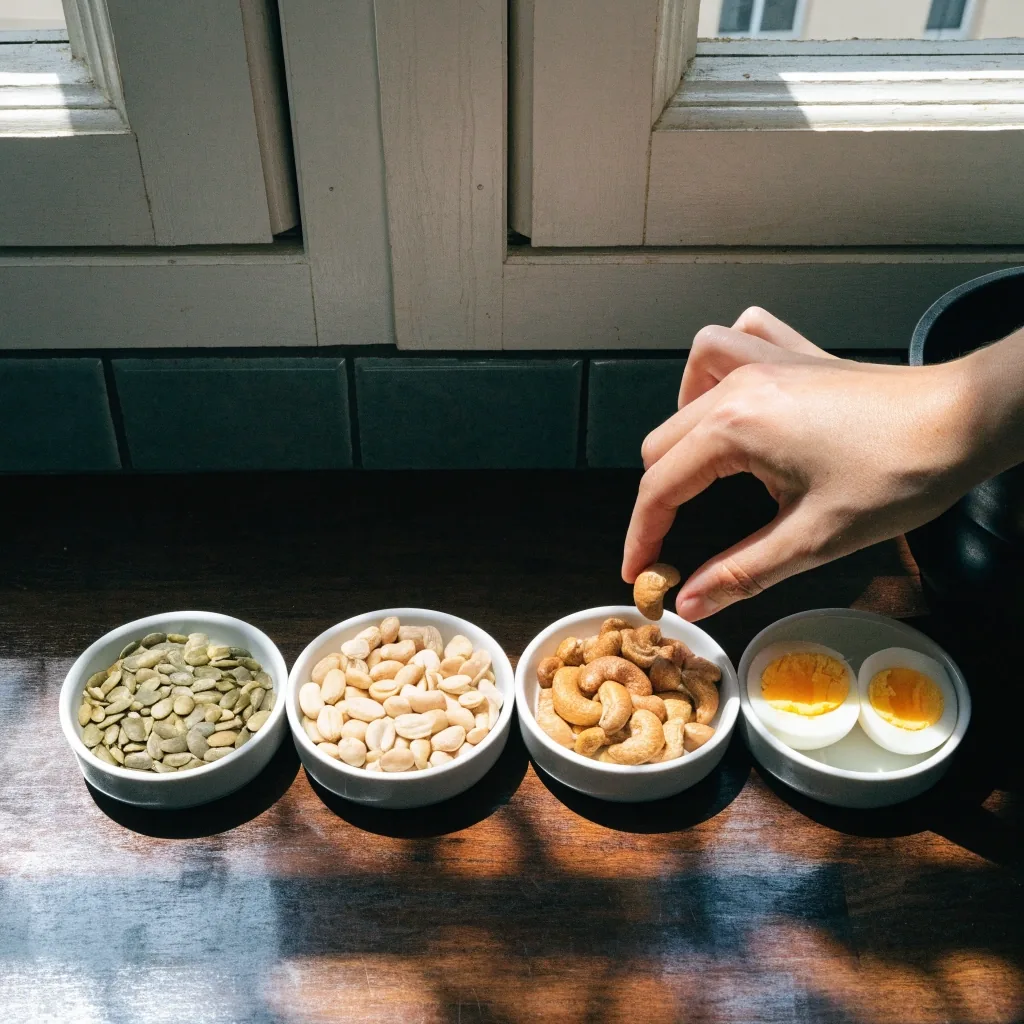
Zinc turns up in the ordinary foods already on most tables here.
Still have a question we haven't answered?
Send it over. We read everything, and the questions that come up repeatedly are the ones that end up as new entries on this page. If your question is about your own eyes, an examination or a prescription, an eye professional is the right place to take it.
Insightful Eye Open · Jl. Cikini Raya No. 58, Menteng, Jakarta Pusat 10330, Indonesia
Monday to Friday, 09:00–18:00 WIB · [email protected]